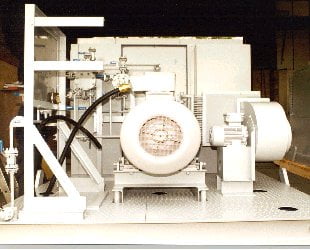
Vapour recovery is the recovery of gases or vapours that would otherwise go to waste. Vapour recovery, therefore, has both economic and environmental benefits. Roots Systems’ blower packages are used in ‘Vapour Recovery Units’ (VRUs) all around the world and are highly sought after for a number of applications.
When gases are liquefied by cooling, they can be stored in an atmospheric tank. Although the tank is continuously cooled, heat from the surrounding atmosphere and electrical equipment will cause some of the gas to boil off. In some circumstances, this ‘boil-off gas’ (BOG) can be drawn from the tank by a blower and used as fuel. Otherwise, a blower passes it through a chiller, where it is reliquefied, and it can then be returned to the tank using a liquid pump, in which case it is a circulation process. This process is commonly used with ammonia, ethylene, liquefied natural gas (LNG), liquefied petroleum gas (LPG) and propylene.
Our compressor packages can be customised for a wide variety of operating conditions down to -196°C (-320°F).
A vent gas blower can be used to recover gas vented from a process where that gas would otherwise go to waste. Unlike a boil-off process, the gas is not recirculated.
Mechanical vapour recovery is a process to recover waste heat. For example, whilst steam is often created deliberately, it is sometimes an unintended by-product of another process: when water is heated, some of it evaporates, carrying valuable energy with it. The heat can be recovered by passing the steam through a heat exchanger. Roots Systems supplies blower packages for this purpose.
There are two kinds of vapour transfer: One in which there is no recirculation and the other involving recirculation.
Blanketing (Offshore Tanker Loading)
When an oil tanker reaches a refinery, crude oil is pumped from the tanker to onshore storage, whilst a ‘blanketing gas’, usually nitrogen, is introduced into the tanker to fill the space previously occupied by the oil. The blanketing gas is necessary to maintain the pressure within the tanker and prevent air from entering, which could mix with oil vapours to create an explosive mixture.
When the oil tanker returns to the offshore oil production facility, crude oil is pumped from the facility to the oil tanker. As the oil tanker fills, the blanketing gas must be vented. In the absence of any vapour recovery system, the blanketing gas would be vented to the atmosphere. Since by this stage the blanketing gas is contaminated with oil vapours, venting it to the atmosphere incurs both economic and environmental costs. Roots Systems supplies blower packages to recover the blanketing gas.
Vapour Transfer Assist (Onshore Tanker Loading and Unloading)
Whenever a volatile liquid is transferred from one atmospheric tank to another, the blanketing gas must be vented from the receiving tank to prevent overpressurisation. Simultaneously, gas must be admitted to the supply tank to prevent the tank from collapsing. In vapour transfer assist, a blower takes the blanketing gas from the receiving tank, complete with vapours, and delivers it to the receiving tank. Not only are the vapours recovered, but the process also facilitates vapour transfer by maintaining a top pressure in the supply tank. Transfer assist is therefore a circulation process.
Roots Systems’ vapour-transfer-assist packages are commonly used on jetties to transfer fuel or liquefied petroleum gas (LPG) between ships and onshore storage.
“Off-gas” simply means any unwanted by-product of a process. Any off-gases can be recovered. The best-known examples of this are carbon capture and flare gas recovery.
Carbon dioxide recovery is another application for which Roots Systems has supplied various blower packages. Hydrogen can be reacted with ‘captured’ carbon dioxide to produce methanol, converting a waste product into a fuel.
‘Routine flaring’ is the burning and venting of natural gas that is considered to be unprofitable, such as ‘associated petroleum gas’ (APG), which is the gas found with deposits of petroleum. The burning of this gas in the atmosphere is both wasteful of a valuable resource and harmful to the environment. Routine flaring has been carried out since the first oil well was dug back in 1859, and, unfortunately, it is still routine in many parts of the world. The World Bank estimated that, in 2021, 144 billion cubic metres of natural gas were burned in this way. A flare-gas recovery system, which includes a train of two compressors, takes the gas from the flare-gas knock-out drum, cools it and removes unwanted contaminants such as hydrogen sulphide. Roots Systems supplies blower packages for the first stage in the compressor train. Some of the recovered gas can be used for fuel on site, whilst the rest is piped to the refinery. Where this is not possible, it is reinjected back into the oil well.
Case study
Case study